

Is there a bedroom in your home that you walk past every day but almost never use? In many Singapore flats and condos, the smallest bedroom starts life as a "study" or "guest room" — and quietly becomes a holding area for the ironing board, an exercise mat, boxes of things you'll deal with later, and a bed that sits empty 350 days a year. The room isn't short on space. It's short on a job.
That's where a sofa bed earns its place. In a compact bedroom, a sofa bed gives one footprint three uses across the day: somewhere to sit and read, somewhere to work or watch something, and somewhere to sleep when a parent visits, a friend stays over, or a teenager needs a room of their own for the school holidays. Nothing is being stored "just in case" — the furniture itself is doing double duty.
In this guide, we'll walk through the decisions that make a bedroom sofa bed work rather than crowd: when it makes sense over a dedicated bed, how to position it so you keep real floor space, how to combine sleep, lounge and storage in one piece, and why an electric mechanism changes how often you actually use the room. These are the same conversations we have with homeowners at our Ubi showroom every week.
When a Sofa Bed Makes Sense in a Bedroom — and When a Dedicated Bed Wins
Not every small bedroom should get a sofa bed. The honest rule is simple: a sofa bed is the better choice when the room needs to be used during the day, not just slept in. A dedicated bed is better when the room has one clear, permanent job.
Use these signals to decide:
- Choose a sofa bed if the room doubles as a home office or study corner, a reading room, a hobby room, or a guest room used fewer than four nights a month.
- Choose a sofa bed if a teenager or young adult uses the room mainly in the evenings and weekends, so a bed is only needed at night.
- Choose a dedicated bed if someone sleeps in the room every single night and the room has no daytime purpose.
- Choose a dedicated bed if the sleeper has mobility or back concerns that need a fixed, single-level mattress. A convertible frame changes the height and surface feel of the sleeping position, so comfort has to be checked in person.
There's also a middle path worth knowing about: the daybed, which sits somewhere between the two. If that trade-off is on your mind, our comparison of a sofa bed versus a separate bed covers the space, cost and comfort maths in more detail.
| Consideration | Sofa Bed in the Bedroom | Dedicated Bed |
|---|---|---|
| Daytime use | Sit, work, read, host | Mostly unused floor area |
| Typical footprint | Compact 2-seater, roughly 1.5–1.9 m wide | Single or super-single frame plus clearance |
| Storage potential | Built-in under-seat compartment | Requires separate drawers or boxes |
| Best for | Guest rooms, teen rooms, study-sleep hybrids | Primary bedrooms, nightly sleepers |
Positioning: Keeping Floor Space Instead of Losing It
Most small bedrooms feel cramped for one reason — the furniture has been placed against the longest wall out of habit, leaving a corridor of leftover floor that can't fit anything. Positioning is where a sofa bed wins or loses.
Start with a floor plan, not a showroom
Measure the room and mark out the sleeping position of the sofa bed at full extension before you buy. That's the number most homeowners forget. A sofa bed needs its open length plus roughly 30–40 cm of clearance at the foot for you to step in and out comfortably. If a bedroom door has only 60 cm of swing, or a wardrobe door needs 70 cm, those clearances need to be honoured in both the sofa and the bed position.
Placement ideas that preserve the room
- Against the longest wall, offset from the corner. Leaving a 40–50 cm gap at one end creates a natural spot for a slim side table and stops the room from feeling boxed in.
- Under a window, if there's no built-in cabinet. This frees the opposite wall for a desk, wardrobe or shelving — the wall you actually look at every day stays useful.
- Opposite the door, not beside it. Keeping the entry sightline clear is the single biggest psychological trick for making a small room feel bigger.
- Float a slim console behind it if the room is wide enough. A 25–30 cm deep console works as a bedside ledge in bed mode and a display or charging surface in sofa mode.
Quick sanity check: if the sofa bed's open length plus clearance doesn't leave at least 60 cm of walking width on one side, the room isn't ready for a fixed bed — but it may still suit a compact sofa bed placed along the wall you rarely cross.
If you'd like a second pair of eyes on the layout, bringing your floor plan to the showroom is genuinely useful — we can walk the measurements through with you against actual pieces rather than catalogue line drawings.
One Piece, Three Jobs: Sleep, Lounge and Storage
The real advantage in a compact bedroom isn't the sofa bed itself — it's the fact that you can stop buying separate furniture for each function. A well-chosen piece replaces a sofa, a bed and a set of drawers, which in turn frees up the walls.
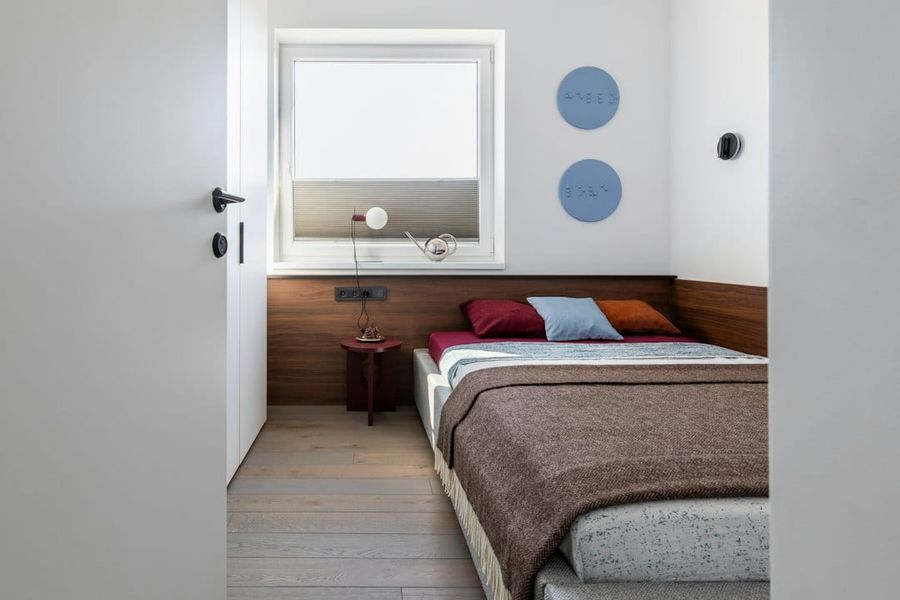
Sleep
Look for a mattress that's 10–15 cm thick with a firm base, not a thin foam pad over a metal bar. This is the difference between a sofa bed that guests describe as "surprisingly comfortable" and one they politely avoid mentioning. A denser foam or pocket-spring mattress also holds its shape better through repeated folding.
Lounge
Seat height matters more in a bedroom than in a living room, because you'll often be sitting with a laptop or a book. Around 42–45 cm seat height with a supportive back and a padded armrest strikes the right balance between a proper couch and something that folds away tidily. Firm foam and a taut frame also mean it won't sag into a hammock shape within a year.
Storage
Under-seat storage is where a bedroom sofa bed pulls ahead of a plain couch. It's the ideal home for the things that only come out when the room becomes a bedroom: folded bedding, pillows, spare towels, an ironing board, or a teenager's out-of-season clothes.
Keeping the Room Clutter-Free with Built-In Storage
The reason small rooms so often look messy isn't a lack of discipline — it's a lack of designated places for things to live. Solve that and the room stays tidy almost on its own.
- Give every item one home. Bedding lives inside the sofa bed's compartment, not on the seat. If a cushion or throw has no home, it becomes clutter by week three.
- Keep one surface deliberately empty. A clear side table or console does more for perceived space than any styling trick.
- Go vertical instead of wide. A tall, shallow shelf or a floating ledge uses wall height that other furniture can't reach — useful in HDB rooms with standard ceiling heights.
- Add one lidded basket. It absorbs the daily overflow (chargers, laundry, a tablet) and tucks beside the sofa bed without needing a cabinet.
- Match the wall colour to the frame. Softer contrast between furniture and walls visually pushes the walls outward and makes a narrow room read as wider.
Our genuine leather electric storage sofa bed was built with exactly this problem in mind: a concealed under-seat compartment for bedding and daily items, upholstery that wipes clean in Singapore's humidity, and a footprint that stays practical in a compact room. Storage isn't an add-on bolted to the frame — it's part of the structure.
If the room isn't a guest room
The same principles adapt to other uses. For a teenager's room, the priority shifts toward durability and a layout that survives school years — see our sofa bed ideas for teen bedrooms. If the room's job is a genuine hybrid — guest room on some nights, work room on others — the dual-purpose room approach is the more suitable starting point.
Electric Mechanisms: Making the Day-to-Night Switch Effortless
Here's the part most people underestimate. A sofa bed only pays off if you actually convert it. If pulling out the frame takes two people, a shove and a grunt, you'll leave the bed permanently open — and the room is back to being a bedroom with an unused sofa on it.
That's the real argument for a motorised or electric mechanism:
- Single-person operation. One hand on the control and the frame glides flat in seconds — no lifting, no reaching behind cushions.
- Consistent alignment. A motor stops at the same position every time, so the mattress doesn't drift or crease over months of use.
- Smoother motion for shared rooms. A slow, controlled glide is far less disruptive if someone is sleeping nearby than a manual frame being folded out.
- Better for older guests. Multigenerational households value the low-effort conversion, especially when the room is used as a guest room for parents.
One practical tip for Singapore homes: keep the power point reachable and avoid trailing cables across the walking path. Planning the outlet position before the sofa bed is placed is much easier than retrofitting afterwards. We cover the mechanism trade-offs in more depth in our electric sofa bed mechanism guide.
Expert Insight: What We Look For in a Bedroom-Ready Sofa Bed
Our pieces are source-selected directly from Foshan manufacturers, and the difference between a sofa bed that lasts five years and one that lasts fifteen usually comes down to parts you can inspect by hand.
Frame. We look for a steel or kiln-dried hardwood mechanism with a smooth, even action and a firm lock at both extremes — no wobble when you sit down hard. Foam. High-density foam in the seat and back keeps its shape under daily use; low-density foam feels soft in the showroom and flattens within a year. Upholstery. Genuine leather develops a natural patina and is straightforward to wipe down in our climate, while quality fabric should be tightly woven with consistent colour across panels. Stitching. Even, reinforced seams at the stress points — the corners, the load-bearing edges and the fold line — tell you how the piece was assembled.
That's also why our showroom sits at Ubi rather than online only. Opening the mechanism, sitting on the seat, feeling the foam density and checking how the bed lies flat are things a photo can't communicate. Once you've chosen, our team handles delivery, installation and after-sales coordination locally — one point of contact from selection through to the day the sofa bed is in your room.
Frequently Asked Questions
What's the smallest bedroom that can take a sofa bed?
As a rough guide, a room of around 2.4 m by 2.8 m can hold a compact two-seater sofa bed along one wall with usable walking space remaining. The deciding factor is the open length plus foot clearance, not the sofa size alone, so measure both positions before deciding.
Will a sofa bed feel as comfortable as a normal bed for guests?
With a 10–15 cm mattress on a firm, flat base, most guests sleep comfortably for several nights. The common cause of an uncomfortable sofa bed is a thin mattress over a sagging bar, which is why we recommend testing the sleeping position in person.
Is an electric sofa bed worth it in a bedroom?
It depends on how often the room changes function. If it becomes a bedroom weekly or more, the effortless conversion is usually worth it. If it converts a few times a year, a well-built manual mechanism may suit you fine. Our Ubi showroom lets you try both.
Making the Room Work Twice as Hard
A small bedroom doesn't need more furniture — it needs furniture that changes with the day. Choose a sofa bed when the room has a daytime job, position it so the open bed and the walking path can coexist, put the under-seat compartment to work holding bedding and daily items, and pick a mechanism you'll actually use without thinking about it. Do those four things and the smallest room in your home stops being the one you avoid.
If you'd like to see how these pieces behave at real bedroom scale, visit our Ubi showroom with your floor plan and room dimensions. You can sit on the sofa, open the mechanism, check the mattress thickness and compare storage capacity with someone who'll walk you through the measurements honestly — before anything goes on a delivery truck. For more ways to shrink furniture footprints without shrinking comfort, browse our small-space sofa bed styling ideas.


