

You've found the sofa you love — a low, clean-lined mid-century piece in warm leather — and then the doubt creeps in: will it actually fit? In a compact HDB or condominium living room, that's exactly the right question to ask. The good news is that mid-century modern design was never built for grand rooms. It grew out of a philosophy of honest materials and efficient form, and its defining features — slim tapered legs, low backs, uncluttered silhouettes — are precisely what keep a small space feeling open rather than packed.
This guide walks through how to make a mid-century sofa work in a real Singapore living room. We'll cover why those clean lines read so well in tight footprints, how to choose a compact mid-century sofa at the right scale, the proportions that stop a room feeling crowded, the slim-profile pieces to pair with it, and a before-and-after example from a typical four-room flat. If you're weighing up a piece like our mid-century top-grain leather electric sofa bed, the measurements and clearances below are the ones worth bringing to a showroom visit.
Why Mid-Century Lines Suit Compact Rooms
Mid-century design isn't just a look — it's a set of structural decisions that happen to be very kind to small rooms. When you walk into a tight living area, your eye reads the gaps as much as the objects. Mid-century furniture deliberately leaves those gaps open.
- Legs you can see under. A raised base lets the floor continue beneath the sofa, so the piece feels lighter and the room reads deeper.
- Low back heights. A back that stays around 75–80cm sits below the window line and doesn't slice the room into awkward horizontal bands.
- No skirts, no bulk. Mid-century sofas skip the heavy upholstered aprons and rolled arms that eat 10–15cm on each side for no seating benefit.
- Horizontal, not voluminous. The proportions are wide and shallow rather than deep and bulky, which suits the elongated footprint of most HDB living rooms.
- Two roles in one. A sofa bed in a mid-century frame gives you seating by day and a guest bed by night — the single most effective space-saving move in a small home.
In a small room, every centimetre of visible floor is a centimetre of perceived space. Mid-century legs and low backs don't just look timeless — they buy you room.
The result is a timeless look that doesn't announce its size. A mid-century sofa styled well reads as a considered choice rather than a compromise.
Choosing a Compact Mid-Century Sofa Bed at the Right Scale
The most common mistake in small-space furniture shopping is choosing by style first and scale second. In a compact living room, scale comes first — the style then has room to breathe.
Measure the room before you fall in love
Bring three numbers to any showroom:
- The wall run where the sofa will sit, edge to edge.
- The walking corridor — the gap between that wall and whatever sits opposite (TV console, dining table, kitchen entry).
- Door swings and lift access, so the piece can actually reach the room on delivery day.
The dimensions that matter most
Rather than chasing a single "small" size, match the piece to your footprint using rough dimension bands:
| Room footprint | Comfortable sofa width | What to watch |
|---|---|---|
| Under 2.5m of wall run | 160–180cm two-seater | Keep depth at 85–90cm so it doesn't dominate the corridor |
| 2.5–3.2m of wall run | 180–200cm two-seater or compact three-seater | Leave one arm clear of the window for visual breathing space |
| 3.2m and above | 200cm+ with chaise option | A low back keeps the longer run from feeling heavy |
Beyond width, check seat height (42–45cm), seat depth (55–60cm) and back height (75–80cm). Shallow seat depth is what makes a compact mid-century sofa feel tailored rather than sunken — and it's the difference between a sofa that fits a small room and one that merely squeezes into it.
Think about the mechanism, not just the day look
A sofa bed is only as space-friendly as the way it opens. An electric mechanism needs very little manual clearance — no kneeling, no dragging the frame out into the walking path — which matters when your floor area is measured in centimetres. As a rule of thumb, leave 40–60cm of free space in front of the sofa so the bed can deploy without touching a coffee table or console.
Proportions That Keep a Small Room From Feeling Crowded
Scale gets the sofa in the room; proportion is what makes the room feel calm once it's there. A few working rules carry most of the weight:
- Two-thirds, not the full wall. Letting the sofa cover roughly two-thirds of its wall run leaves negative space at the ends, which stops the room feeling wall-to-wall.
- Clear walking corridors. Keep 45–60cm of open floor between the sofa and the nearest opposing furniture — enough to pass comfortably without a shuffle.
- Coffee table gap of 40–45cm. Close enough to reach a cup, far enough that the floor between reads as a path, not a gap.
- Anchor with one rug. A low-pile rug that extends a little past the sofa's front legs groups the seating and makes a small zone feel intentional, while tiling or timber around it keeps the floor area visible.
- Layer heights vertically. A low sofa plus a mid-height side table and one tall slim lamp draws the eye upward, so the room feels taller instead of wider than it is.
Pair With Slim-Legged, Low-Profile Pieces
One generously proportioned piece can undo the good work of a slim sofa. In compact spaces, choose companions that share the same logic: lift the floor, drop the height, remove the mass.
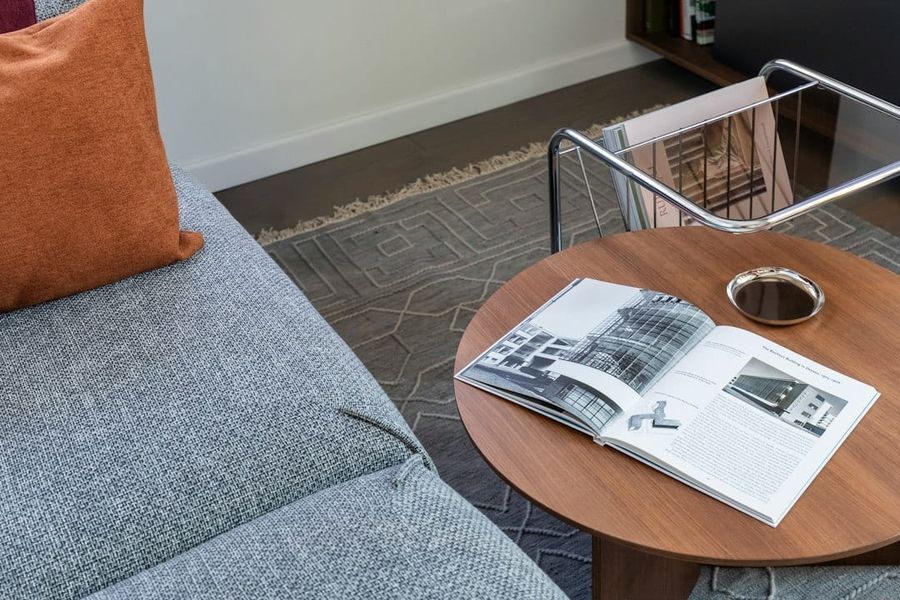
- A slim-legged side table rather than a bulky drawer unit — it holds a lamp and a drink without visually closing off the corner.
- A low, round coffee table. Curves soften the angles of a narrow room and a slim profile keeps the walking path intact.
- An open console or slatted bench instead of a solid cabinet — you can see through it, so the wall behind it still counts.
- A single armchair on legs, not a pair of heavy tub chairs, if you want extra seating without the room closing in.
- Skinny floor or arc lamps. They replace a ceiling pendant's visual weight and free up surface area on side tables.
Keep the palette restrained, too: warm neutrals, walnut or oak tones, and one leather anchor. A quieter palette makes a small room read as composed — which is what makes mid-century styling feel timeless rather than trend-led. For more on this, see our guide to styling a mid-century modern leather sofa in a Singapore home.
A Compact-Room Transformation: A Typical Four-Room Flat
Here's how the principles come together in a real setup — a four-room HDB living room around 3.1m by 3.6m, with the main window on one side and the kitchen opening on the other.
| Before | After |
|---|---|
| Deep, skirted three-seater with rolled arms covering most of the wall | 185cm mid-century leather sofa bed on slim tapered legs, set to about two-thirds of the wall run |
| Oversized rectangular coffee table blocking the walking path | Low round table with a 42cm gap to the sofa, keeping the corridor clear |
| Dark, dense rug that visually shrank the floor | Pale low-pile rug extending just past the sofa's front legs |
| Tall solid cabinet crowding the corner | Open console plus a slim arc lamp, freeing the corner and lifting the eye |
The footprint barely changed — the perceived space did. The electric sofa bed also means the room becomes a guest bedroom when needed, without a second piece of furniture occupying the floor the rest of the year. For a deeper dive into arranging around this kind of dual-purpose piece, our article on styling a small space around a sofa bed covers the evening-to-overnight reset in detail.
Expert Insight: What We Look For at the Source
Because mid-century frames are open and exposed, there's nowhere to hide inferior construction. When we source from partner workshops in Foshan, the details we check first are the ones you'll feel years later: kiln-dried hardwood frames that hold their shape in Singapore's humidity, top-grain leather with a natural grain that wears rather than peels, and tapered solid-wood legs that are properly joined rather than simply screwed into a soft panel. We test the bed mechanism through repeated cycles before it earns a place on the showroom floor, and we match foam density to the seat's depth so a compact sofa stays supportive rather than sagging in the middle. It's a slower way to buy — but it's why a well-chosen mid-century piece stays timeless instead of needing replacing in three years.
Bringing It Home
Mid-century design and compact Singapore living rooms are a natural match. Visible legs, low backs and uncluttered proportions let a small space keep its floor area and its sense of calm — and a well-scaled compact mid-century sofa bed gives you seating and a guest bed in a single footprint.
If you take one thing away: choose by scale first, style second. Measure your wall run and walking corridor, aim for a sofa that covers around two-thirds of the wall, keep 45–60cm of clear floor around it, and pair it only with slim-legged, low-profile companions.
Sit on it before you decide. Leather grain, seat depth and mechanism smoothness are things photographs can't fully convey — especially in a compact room where every centimetre counts.
Our showroom in Ubi, Singapore is set up so you can do exactly that: sit on the mid-century leather sofa beds, check the dimensions against your own floor plan, and talk through delivery, installation and after-sales support with the team. Bring your measurements — we'll help you confirm what fits before you commit.
Looking for more compact-room thinking? Our guide to small bedroom sofa bed ideas and our piece on mixing mid-century pieces with modern decor are good next reads.


