

There is a moment every Singapore homeowner knows. You have fallen for the idea of a recliner — the footrest that glides out after a long commute, the full recline on movie nights — and then you stop yourself. Will it look like a dated lounger parked in the middle of my modern living room?
It is a fair worry, and you are not alone in having it. But the honest truth is that a recliner only looks bulky or dated when the design and the styling around it do the work against each other. Contemporary recliner sofa styling is about bridging comfort and clean lines — choosing a silhouette that already reads modern, then dressing the space around it so the sofa belongs rather than stands out.
In this guide, we walk through five practical steps: picking a contemporary recliner design, layering it with cushions, throws and rugs, positioning it to integrate with the room, coordinating colour, and balancing multiple recliner seats without visual clutter. No redesign of your whole flat required — just a smarter way to style the seating you actually want.
1. Choose a Recliner Design That Already Reads Contemporary
Here is a styling secret the showroom teaches quickly: half of good recliner sofa styling happens before you buy anything. If the frame is boxy, overstuffed or fussy, no cushion arrangement will fully rescue it. Start with a design that carries its own clean, modern language:
- A tailored, low-profile frame. Look for clean horizontal lines, firm squared arms and a base that sits close to the floor — the same visual grammar as a contemporary sofa. Avoid cavernous barrel backs and puffy rolled arms, which are what give recliners their dated reputation.
- Genuine leather over clunky fabric. Leather catches light, develops a subtle patina and reads instantly more premium. A cognac or charcoal hide keeps the piece looking architectural rather than soft and shapeless.
- Discreet mechanism. On a quality unit, the recline control is hidden in the arm or side panel — not a protruding lever or chunky handle that shouts "mechanism here."
- A wall-hugger configuration. In compact HDB and condo living rooms, a wall-hugger recliner needs far less clearance behind it, so it can sit naturally against the wall like any other sofa instead of floating awkwardly mid-room. It is a design decision that makes styling far easier from day one.
Our Wall Hugger Power Recliner Sofa with USB, available from a single seat up to a four-seater, is built on exactly this principle: a sleek, tailored profile that happens to recline. If space planning is your main concern, our guide to wall-hugger recliners for compact Singapore living rooms walks through the clearance math in detail.
2. Style Around the Sofa: Throws, Cushions and Rugs
Once the right frame is in place, the styling that makes it feel intentional is mostly about what happens around it. The goal is to make the recliner read as part of a layered, curated room — not a single standalone appliance.
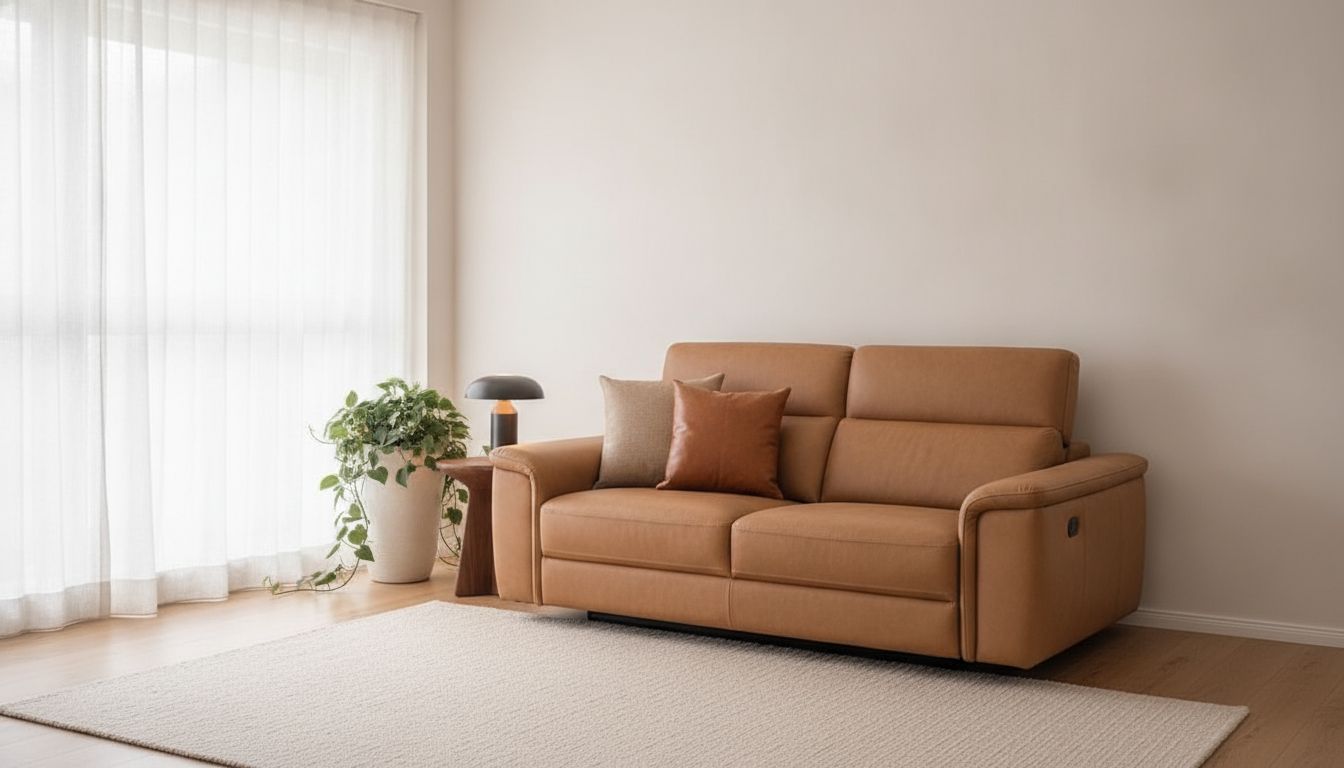
- Anchor it with a rug. Place a low-pile or flat-weave rug under the front two-thirds of the sofa so the piece visually sits in the space, not on top of it. This single move does more for integration than any other styling trick.
- Dress the seats in odd numbers. Three cushions — two larger backrests and one smaller lumbar — feel styled; two matching squares feel like a showroom set. Vary the sizes and let each one lean at a slightly different angle for that effortless, relaxed look.
- Add a throw with intent. Drape a textured throw over one arm or across the back corner. It softens the leather, adds warmth for air-conditioned evenings, and — practically — protects the hide from daily wear in our tropical climate.
- Keep controls reachable. If it is a power recliner, leave the side panel and any charging ports accessible rather than burying them under cushions. Function is part of the aesthetic.
The trick throughout is restraint: a recliner sofa is already a strong object, so cushions and throws should bridge it to your palette rather than compete with it.
3. Position It to Belong — Don't Banish It to a Corner
The most common styling mistake is treating the recliner as a loner: exiled against a wall with nothing around it, it ends up looking like a medical recliner in a waiting room. Integrate it into the room's seating arrangement instead:
- Angle it toward the room's focal point — the TV, the window view or the coffee table — so it participates in the conversation instead of staring into space.
- Flank it with companions. A slim side table on one side and a floor lamp or plant on the other makes the recliner one element of a composed vignette, not an island.
- Face it toward other seating. In a family room, positioning the recliner opposite or at a gentle angle to the main sofa turns it into part of the conversation circle. This is where a wall-hugger shines: it can sit near the wall and still leave a clear walkway for reclining.
- Give the recline room to breathe. Whatever the mechanism, always leave clear floor space in front for the footrest to extend. Measure the recline arc before committing to a layout — nothing undoes a contemporary look faster than a footrest scraping the coffee table.
4. Coordinate Colour — Don't Compete
Colour is where recliner sofa styling either comes together or falls apart. The reliable approach is to treat the recliner as the neutral foundation of your living room palette, then introduce colour through cushions, art and accessories. As a starting guide:
| Leather tone | Room palette it flatters | Accent cues |
|---|---|---|
| Cognac / tan | Warm whites, beige, taupe, wood tones | Rust, olive, burnt orange cushions |
| Charcoal / grey | Cool whites, concrete, black accents | Mustard, blush or teal for contrast |
| Dark brown | Cream walls, rattan, warm lighting | Cream and sand-toned throws |
| Black | Light floors, high contrast, minimalist | Soft greys and one warm accent |
If you are still deciding on the leather finish itself, our comparison of genuine leather versus faux leather for recliners covers how each wears in Singapore's humidity — worth reading before you commit. And once the recliner is anchored in a neutral tone, the wider scheme becomes far easier: our post on sofa colour palettes that make compact Singapore spaces feel bigger shows how to keep the whole room light and airy around it.
5. Balancing Multiple Recliner Seats Without the Showroom Row
Households with two people who both want to recline face a special styling challenge: two identical loungers side by side can start to look like a row of seats at a cinema. The fix is to treat multiple recliners as a suite rather than a set:
- Mix recline with non-recline. One recliner paired with a fixed sofa (or a recliner sofa where only the end seats recline) reads as a designed arrangement; a full row of dedicated loungers reads as a cinema.
- Angle paired seats inward. Two recliners facing each other at a slight angle — with a console or coffee table between — creates a lounge conversation zone instead of parallel seating.
- Keep the upholstery consistent. If the seats share the same leather tone and design language, they coordinate. Break the row visually with a rug, a plant or a floor lamp between or beside them.
- Use the console as a divider. On larger configs, a centre console with built-in storage and USB ports separates two recline zones while adding function — exactly the setup the Wall Hugger Power Recliner Sofa range was designed around.
Key takeaway: a recliner looks contemporary when it is treated like any other designer sofa — anchored on a rug, layered with soft furnishings, coordinated in colour and positioned as part of the room's seating story. The recline is a feature, not the identity.
From Our Showroom: What "Contemporary" Looks Like in Real Homes
When we source recliners from our Foshan partners, we evaluate them the way a stylist would, not just the way an engineer would. Three details separate a contemporary recliner from a dated one:
- Proportion and stitching. We look for clean, even seam lines and frames where the height of the backrest stays proportional to the seat depth — proportions are what make a sofa look modern in a photograph and in person.
- Leather quality you can see and feel. Genuine full-grain hides take on a rich character over time; the grain and the way light falls across the surface are the difference between "premium" and "plastic-looking."
- Mechanism smoothness. A quality recline should glide quietly without jerking. If it feels smooth in the showroom, it will feel refined in your living room — and the power recline on our wall-hugger units tucks away so neatly that guests often can't tell it is a recliner at all until someone reclines.
That is also why we encourage you to sit in these pieces before styling them in your head. Comfort, sightlines and mechanism feel are things no photograph can convey.
Make Comfort Look Intentional — Start in Our Ubi Showroom
A modern recliner sofa living room — Singapore-sized and Singapore-styled — is absolutely achievable. The formula is simple: choose a tailored, wall-hugger design; anchor it on a rug; layer it with cushions and a throw; coordinate its leather tone with your palette; and position it as part of the room, never apart from it. Comfort stops being a compromise the moment styling stops being an afterthought.
The best next step is to see the difference in person. Visit our showroom at Ubi, where you can test the recline mechanism, feel the genuine leather grain under natural light and get a one-to-one consultation on how the piece will sit in your floor plan. We will even talk through delivery, installation and after-sales coordination so your new sofa looks — and stays — contemporary for years.
Planning a compact living room? Start with our guide to wall-hugger recliners for small Singapore spaces, or drop by the showroom and let us help you put the whole scheme together.


